Current Research
My current research in the Gianneschi Lab is on the synthesis and spectral properties of cyanine dyes that we use to label DNA, peptides, and nanomaterials. After developing an efficient and economical route to Cy7 and Cy5.5, I synthesized a library of different symmetric and asymmetric dyes in order to study the effects on spectral properties that resulted from changing different aspects of the dyes' structures.

Cyanine Dyes
- Good for in vivo imaging because a biological matrix exhibits the least absorption and autofluorescence background in the near-IR range, especially compared to the wavelength ranges of fluorescein and TAMRA (see below)
- NIR light has the capability to penetrate tissue more efficiently than light in the visible range
- Short fluoresence lifetimes (400-700 ps) means they are less susceptible to photobleaching
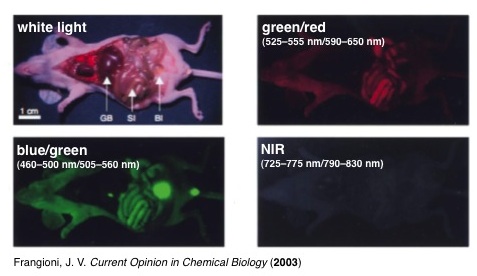
The above image shows the absorption and autofluorescence of biological tissues at different wavelength ranges (excitation nm/emission nm). Dyes like fluorescein and TAMRA are unsuitable for deep tissue in vivo imaging since the skin and hair, along with most other tissues, have very high absorption and autofluorescence in the green/red and blue/green ranges. However, in the near-IR range, there is basically no background autofluorescence, so NIR dyes are crucial for in vivo imaging of our nanomaterials.
Synthesis of Heptamethine Indocyanine Near-Infrared Dyes
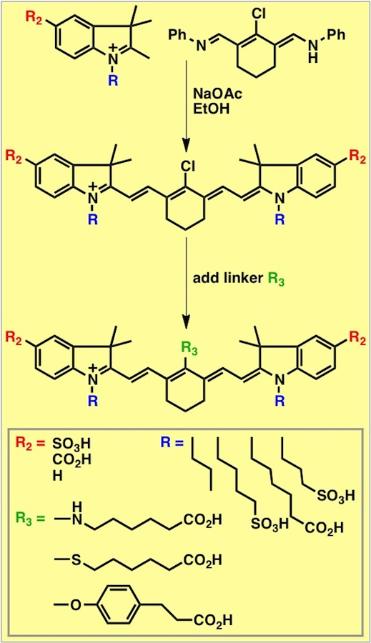
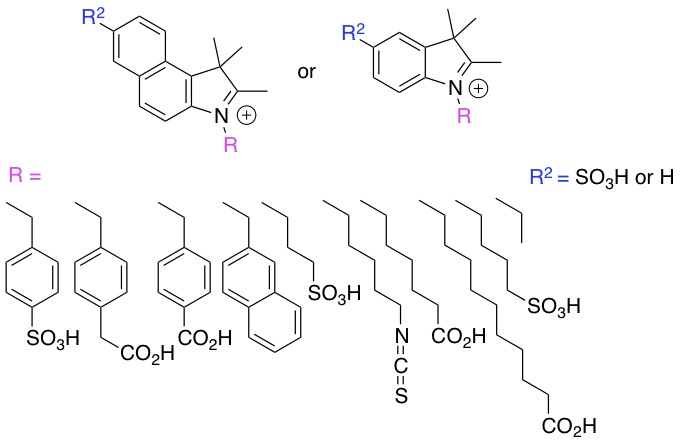
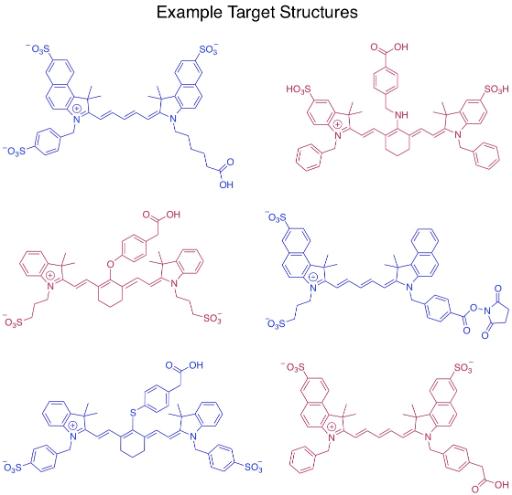
The very high cost of commercial cyanine dyes was the initial motivation for synthesizing the dyes myself, but the unique properties of cyanine dyes and the variety of different structural motifs that I saw in the commercially available compounds made me want to investigate the effects on the spectral properties that might result from changing structural features of cyanine dyes. After developing synthetic routes to both symmetric and asymmetric cyanine dyes, I made a library of different indolenine building blocks to use with the intention of comparing the spectral properties of the dyes made from using various combinations of indolenines. A few of the building blocks are shown below, followed by examples of target cyanine dye structures:
Past Research
.jpg)
The first imaging agents I synthesized were the fluorescent dyes fluorescein and tetramethylrhodamine (TAMRA) for labeling DNA, peptides, and nanomaterials. The synthesis of the carboxylic acid derivatives was the first step, followed by modification to the pentafluorephenyl- or NHS-esters for labeling of peptides, making monomers or termination agents for ROMP, and incorporating into oligonucleotides via modified thymidine phosphoramidites (shown below).
.jpg.opt585x329o0,0s585x329.jpg)
.jpg)
References
Khanna, P. L.; Ullman, E. F. Analytical Biochemistry (1980)
Ueno, Y.; Jiao, G.; Burgess, K. Practical Synthetic Procedures (2004)
Adamczyk et al. Journal of Organic Chemistry (2000)
Ciurea et al. Nucleosides, Nucleotides & Nucleic Acids (2001)
Patonay et al. Analytical Chemistry (1994)
Chen et al. Journal of Photochemistry and Photobiology (2006)
Shao et al. Dyes and Pigments (2011)
Mujumdar et al. Bioconjugate Chem. (1996)
Gianneschi Group:
Chien et al. Angew. Chem. (2010)
Thompson et al. Nano Lett. (2010)
Chien et al. Chem. Comm. (2011)
Chien et al. Small (2011)
Ku et al. J. Am. Chem. Soc. (2011)
Hahn et al. Chem. Comm. (2011)
Randolph et al. Chem. Sci. (2012)
Chien et al. Chem. Sci. (2012)
Chien et al. Submitted (2012)
